

Someone can now make a video of you saying something you would never say, and you may have to fight to get it taken down.
What actually happened
On 17 September 2026 the Oversight Board, the independent panel that reviews the hardest decisions about what is allowed on Facebook and Instagram, published two rulings. In both it overruled Meta, the company behind both apps, and ordered a video taken down.
The first was a deepfake: a clip made with artificial intelligence (AI, software that learns from huge amounts of data) that puts a real person’s face and voice onto words they never spoke. It showed a Labour Party councillor in Scotland appearing to say something hateful about refugees. The fake was not obvious; the giveaway was that her voice did not match her facial movements. She reported it, and so did someone else. Meta never sent the post to a human reviewer, decided it broke none of its rules, and gave it no “AI-generated” label.
The second case is the one to remember. A young Muslim woman in Europe gave a single television interview as a volunteer campaigner for better menstrual health education. Accounts on several platforms then used that footage to build fake videos of her. In the post the Board reviewed, an AI version of her announces herself as her country’s new health ambassador. The caption repeats the false claim next to a laughing emoji, and the comments mock her weight and her hijab. The clips of her drew tens of millions of views across platforms. Her report and her appeal were both closed automatically, and Meta told the Board that leaving the post up matched its own rules. The Board has now ordered it removed.
Why this matters even if you are not in the public eye
You do not need a public profile to be a target. One interview, one profile photo, or a few seconds of your voice is enough material to build a fake around.
There is money in it too. A fake video or a copied voice is a powerful way to ask for help: a panicked message from a “relative” in trouble, or a famous face recommending an investment.
The harm does not fall evenly. Women politicians, journalists and campaigners are targeted far more often than men, and the Board quotes a 2025 United Nations report describing these attacks as “often deliberate and coordinated and aimed to silence women in public life.” The less well known you are, the less help you get.
The quieter cost: once convincing fakes are everywhere, real footage gets waved away as fake too. In the Board’s words, deepfakes “erode trust in all public information.”
What you can actually do
None of this needs any technical skill.
- Slow down when a video asks you for something. If a clip asks for money, a code or personal details, treat it as a claim rather than proof, and call the person back on a number you already have.
- Agree a family password for emergencies, something only your household knows. A real relative can answer it.
- Look for the small mistakes: a voice drifting out of step with the mouth, strange blinking, hands that blur or change shape.
- Check who posted it. A clip on a page you have never heard of, with nobody else reporting it, is a reason to wait.
- Report it, then follow up. On Facebook, open the post, tap the three dots and choose Report. Keep the link.
- Set personal photos, videos and voice notes to friends-only.
- If it happens to you, save the link, screenshots and dates before reporting, and ask for a human review.
Common misunderstandings
Myth: I would spot a fake straight away
The Board found the councillor’s video “would not be immediately obvious to most viewers” as a fake. Its clues showed up only on close inspection, and it stayed online for months.
Myth: This only happens to famous people
The second case was a private individual, filmed once as a volunteer, and the Board called Meta’s bullying rules “inadequate to address AI manipulated imagery of people not normally in the public eye.”
Myth: Reporting it gets it removed
In both cases the first report and the first appeal were closed without a person reviewing them. The videos came down only after the Oversight Board took the cases.
Myth: It is only a joke, so nobody gets hurt
The Board treated both videos as false claims about real women rather than humour, and one as hate speech against refugees as a group. The councillor described the impact on her as significant and quite traumatic.
What to watch for next
The Board’s rulings on individual posts are binding, but its wider advice is not: Meta must respond to the recommendations and can decline to change anything. This week it was asked to lower the bar for its “high risk” AI labels, to put a warning screen in front of some labelled videos, to show labelled posts to fewer people, and to publish how often the labels are used.
Expect more labels and warning screens in your feed, and treat them as helpful rather than complete: the post at the centre of this week’s second case carried no AI label at all.
The one thing to remember
A video is no longer proof that something happened, and a face or a voice is no longer proof of who is speaking. When a clip asks you to act, check it through a second channel you already trust.
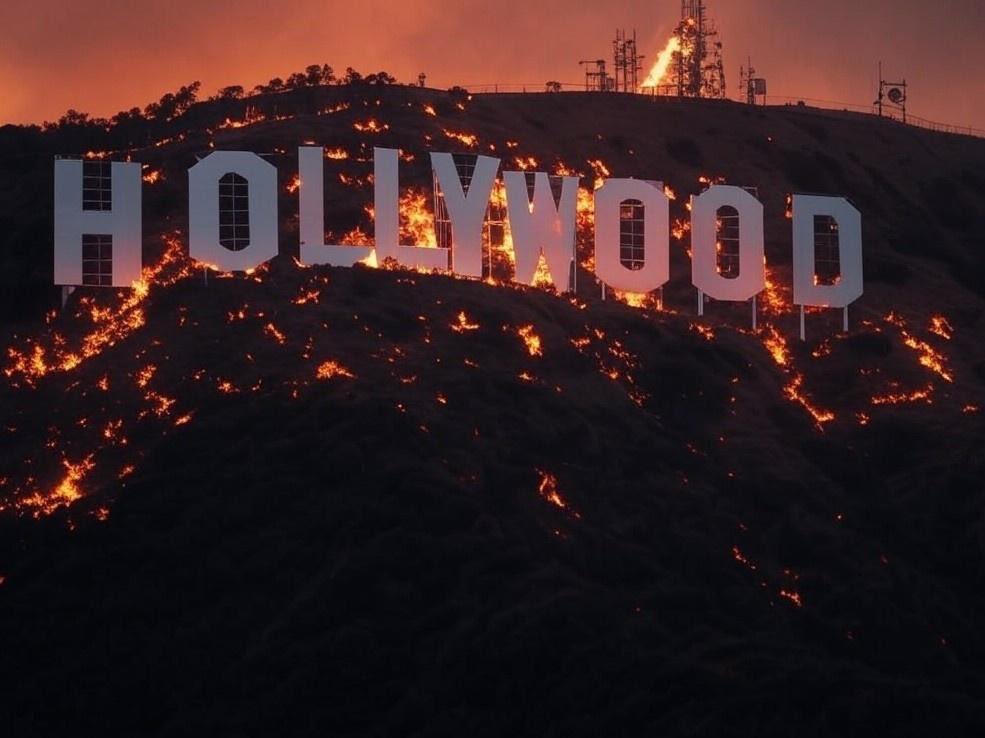
Image credits: cover image “Male and female deepfake” by Vahan03, Wikimedia Commons, public domain (a machine-made image has no human author). In-text image: AI-generated fake of the Hollywood sign, January 2025, Wikimedia Commons, public domain. Files: commons.wikimedia.org